01 47 20 48 70

French version — the French version is the authoritative one.

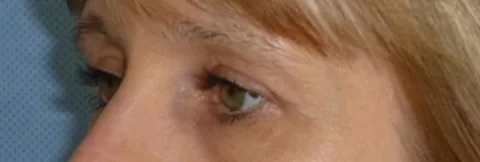
Gros plan sur le regard d'une patiente, illustrant un rajeunissement des paupières réalisé par le Dr Pulvermacker à Paris

Blepharoplasty in Paris 16 — eyelid rejuvenation surgery

Blepharoplasty corrects excess skin on the upper eyelids and the fatty bags of the lower eyelids. Of all facial procedures it is the one with the most favourable ratio between the size of the operation and the effect obtained: it is short, causes little pain, has a brief recovery, and appreciably changes the expression of the eyes.

The aim is to rejuvenate the eyes without changing their expression. An eyelid from which too much has been removed hollows the socket, rounds the eye and hardens the face: that is the main pitfall of this surgery, and the reason why restraint matters more here than the extent of the procedure.

What is a blepharoplasty?

Two distinct mechanisms combine in the periorbital region.

Above, the skin of the upper eyelid — the thinnest in the body — loses its elasticity and forms an excess that falls over the eyelid crease. This excess weighs the eyes down and may, when significant, obstruct the upper visual field or force permanent contraction of the forehead muscle.

Below, the partition that holds back the orbital fat — the orbital septum — becomes lax. The fat then bulges beneath the eye: these are the eyelid bags. It is therefore not an excess of fat, but a failure of containment.

This distinction dictates the technique: above, skin is removed; below, it is most often the fat that is treated.

Why do the eyes look tired?

Correcting tired-looking eyes is the commonest reason for consulting, and it covers several situations that must be distinguished before any discussion of technique:

  • excess skin on the upper eyelids, which may go as far as interfering with vision;
  • bags under the eyes giving a permanently tired look, even after a full night's sleep;
  • a hollow tear trough darkening the junction between eyelid and cheek;
  • a dropped eyebrow accentuating the heaviness of the lid without the eyelid itself being at fault;
  • genuine eye fatigue, caused by permanent contraction of the forehead to clear the field of view.

Eyes may therefore look tired for reasons that are not all a matter of the eyelid. It is the clinical examination that decides, and it happens that the answer is not surgical.

Upper blepharoplasty

It consists in removing the excess skin between the eyebrow and the eye, and sometimes a small amount of fat in the inner part of the eyelid.

The scar is concealed in the upper eyelid crease, halfway up the lid, at the junction between its mobile and its fixed part. With the eye open it is not visible; with the eye closed it merges with the natural crease.

Duration: 30 to 45 minutes.

The amount of skin removed is the decisive parameter. A measured excision lightens the eyes; an excessive one prevents the eye from closing fully and permanently alters the expression.

Résultat chirurgie des paupières - Dr Pulvermacker, Paris

Lower blepharoplasty

Two situations, two techniques.

Eyelid bags without excess skin — the commonest situation. The approach is through the inner surface of the eyelid, across the conjunctiva: this is the transconjunctival approach. It allows the herniated fat to be removed or repositioned. No skin incision is made.

Bags with genuine excess skin. Removing skin becomes necessary, requiring a subciliary incision placed one or two millimetres below the lash line. This scar usually becomes barely visible.

The difference between these two techniques is important to grasp: the transconjunctival approach does not disturb the support of the lower eyelid and thereby avoids the risk of retraction, a complication specific to the skin approach when excision is excessive. That is why it is preferred whenever the anatomy allows.

Eyelid bags, tear troughs and malar bags: three different things

Patients use these three terms interchangeably, whereas they describe three distinct anatomical realities that do not call for the same treatment.

Eyelid bags are a bulge of orbital fat through a lax septum. They sit immediately below the free margin of the eyelid. This is the classic indication for lower blepharoplasty.

Tear troughs cover two different mechanisms. The pigmented shadow is a colouring of the skin, constitutional or vascular in origin: surgery has no effect on it. The hollow trough, on the other hand, is a deficit of volume at the junction between eyelid and cheek: it calls for repositioning of the fat or an injection of hyaluronic acid, not an excision.

Malar bags, sometimes called festoons, sit lower down: on the cheekbone itself, below the orbital rim. They are pockets of fluid infiltration, often varying from one day to the next and worse in the morning. This is essential: a lower blepharoplasty does not correct them, and may even make them more visible by clearing the area above. Their treatment is different and must be stated as such before any operation.

Confusing these three entities is the leading cause of disappointment after eyelid surgery. Distinguishing them in consultation, with photographs to hand, is part of the assessment.

Should all four eyelids be operated on?

Not automatically, but it is common. The upper eyelids alone, the lower alone, or all four can be treated during the same operation.

Operating on all four eyelids means a single anaesthetic and a single recovery, and avoids a mismatch between a treated level and an untreated one. Treating only the upper eyelids in a patient with marked bags leaves a visibly partial correction.

Correcting a rounded eye or an ectropion

Some patients consult not for a first operation, but because the position of their lower eyelid has changed: after previous eyelid surgery, after an injury, or through the laxity of the tissues with age.

The rounded eye — or scleral show — describes a drop of the free margin of the lower eyelid that exposes the white of the eye below the iris. The eye loses its almond shape and looks round, staring, with a gaze that seems fixed.

Ectropion is the next stage: the lower eyelid turns outwards and loses contact with the globe. It is no longer only a question of shape: watering, chronic irritation and exposure of the cornea make it a functional problem.

These situations require corrective surgery distinct from the original blepharoplasty. The principle is no longer to remove, but to restore support to the lower eyelid: re-tensioning of the lateral canthal tendon (canthopexy or canthoplasty), and depending on the case the addition of tissue to make up for what is missing in height.

The preliminary assessment takes longer than for a first-line blepharoplasty: the laxity of the eyelid, the state of the cornea, the quality of the tear film and the amount of skin actually available all have to be evaluated. Not every situation can be fully corrected, and the realistic degree of improvement is stated before the operation.

How does the operation proceed?

Depending on the overall assessment of the face, blepharoplasty may be combined with a cervicofacial lift, with lipofilling of hollow tear troughs, or with treatment of the skin quality.

What is the recovery like?

This operation has the particularity of being virtually painless.

Day 0 to day 2. Cold compresses. A feeling of tightness and dry eyes. Temporarily blurred vision caused by the eye ointment.

Day 2 to day 10. Swelling and bruising of the eyelids, of variable intensity from patient to patient, subsiding within seven to ten days.

Day 5. Stitches removed.

From day 10. Make-up becomes possible again. Returning to social life is generally feasible by then.

Avoid wearing contact lenses for about two weeks, as well as exertion and head-down positions during the first week.

How is eyelid swelling managed?

Bruising and swelling of the eyelids are the rule in the early days, and they are what surprises patients most: the eyes take a little time to look like your own again. Local care is delivered by the practice nurses, and the surgeon sees you within seven days, then between day ten and day fourteen, before sutures are removed. Manual lymphatic drainage may be offered at home where indicated, as may the hyperbaric oxygen therapy available at the practice. The full arrangement is described under post-operative care.

When can you fly again?

Seven to fourteen days, with a preference for ten to fourteen if the flight is long. The two landmarks are the removal of the stitches and the fading of the bruising.

One point is specific to this operation: cabin air is very dry, and an ocular surface that is still fragile tolerates it poorly. Artificial tears should be planned for throughout the flight, without waiting for discomfort.

Physical activities — diving, riding, contact sports — wait longer than the flight itself: two to four weeks.

The times given apply to a short flight. A long-haul flight adds several hours of immobility and dry air: if your journey exceeds four hours, the interval is reassessed accordingly.

When is the result final?

Three to six months are needed to judge the result, the time for the scars to fade and for residual swelling to disappear completely.

For surgery correcting a rounded eye or an ectropion, this period is longer: the position of the eyelid continues to settle for up to six months, sometimes more.

What are the risks?

The risks of eyelid surgery are rare.

Epidermal cysts

along the scars: common, harmless, removed in consultation.

Dry eyes

temporary, more marked in patients who already suffered from it.

Haematoma

rare; retro-orbital haematoma is exceptional but constitutes an emergency.

Healing problems

rare.

Retraction of the lower eyelid

with a rounded eye or even an ectropion: a complication specific to the subciliary approach where excision is excessive or support insufficient, hence the preference for the transconjunctival approach whenever possible, and the addition of a canthal support procedure where the eyelid is lax.

Asymmetry

moderate, to be distinguished from pre-existing asymmetry, which is almost always present and should be documented before the operation.

The SoFCPRE information leaflet is given in consultation.

Is blepharoplasty reimbursed?

Upper blepharoplasty may be eligible for reimbursement where the excess skin causes a documented impairment of the visual field. This impairment must be evidenced by an ophthalmological examination — visual field with and without the eyelid raised — and is the subject of a prior authorisation request.

Correction of an ectropion is likewise a functional indication and may be reimbursed.

Lower blepharoplasty for eyelid bags is purely aesthetic and is not reimbursed.

Frequently asked questions

What is the difference between upper and lower blepharoplasty? The upper removes the excess skin that weighs down the top eyelid. The lower treats eyelid bags and, more rarely, excess skin beneath the eye. Both can be performed during the same operation.

Does blepharoplasty correct tear troughs? Only hollow troughs, linked to a deficit of volume at the eyelid-cheek junction. Pigmented shadows, which are a colouring of the skin, are not a matter for surgery.

Does blepharoplasty correct malar bags? No. Malar bags sit on the cheekbone, below the orbital rim, and do not have the same mechanism as eyelid bags. A lower blepharoplasty may even make them more apparent. Their treatment is specific and discussed separately.

What is a rounded eye after a blepharoplasty? It is a drop of the lower eyelid margin that exposes the white of the eye and causes it to lose its almond shape. It results from a failure of eyelid support. Its correction rests on re-tensioning the lateral canthal tendon, possibly with the addition of tissue.

Can an ectropion be corrected? Yes, in the majority of cases. The technique depends on the laxity of the eyelid and the amount of skin available. The pre-operative assessment establishes precisely what degree of improvement is realistic.

Does the result change the shape of the eyes? No, where excision is measured and eyelid support respected. It is excessive excision that hollows the socket and rounds the gaze.

How long before returning to work? Seven to ten days on average.

Can a blepharoplasty be combined with a facelift? Yes, it is a frequent and logical combination. The cervicofacial lift treats the lower third of the face and the neck, blepharoplasty the eyes: the two procedures are complementary and are carried out under the same anaesthetic.


Before-and-after photographs

These photographs are published with the agreement of the patients concerned. They illustrate individual results and do not constitute a guarantee of outcome. Every anatomical situation is different.

→ See the before-and-after blepharoplasty gallery

Consultation in Paris 16

Dr Benjamin Pulvermacker

14 rue Pétrarque, 75116 Paris

Telephone: 01 47 20 48 70

Metro: Trocadéro (lines 6 and 9), Boissière (line 6)

→ Request a consultation

Last updated: August 2026

Medical content written and reviewed by Dr Benjamin Pulvermacker, board-qualified plastic surgeon (Medical Council no. 75/72049), Paris 16.

Before / After

Pour qui cette intervention convient — et pour qui elle ne convient pas

Elle convient aux personnes gênées par un excès de peau des paupières supérieures qui alourdit le regard, ou par des poches des paupières inférieures qui donnent un air fatigué permanent, indépendamment du sommeil. Elle ne convient pas lorsque la plainte relève en réalité d'une chute du sourcil (qui appelle un autre geste), d'un cerne pigmenté (qui ne relève pas de la chirurgie), d'une sécheresse oculaire sévère non contrôlée, ou d'une attente de rajeunissement global du visage qu'une chirurgie limitée aux paupières ne peut pas offrir. L'examen distingue précisément ces situations.

Limites et risques spécifiques

La blépharoplastie ne traite ni les rides de la patte-d'oie, ni la position du sourcil, ni la qualité de la peau. Ses risques propres, rares mais réels : correction excessive ou insuffisante, asymétrie, œil rond ou rétraction de la paupière inférieure, sécheresse oculaire transitoire, kystes cicatriciels ; l'hématome rétro-orbitaire, exceptionnel, est une urgence. Les ecchymoses visibles durant une à deux semaines imposent d'anticiper les obligations sociales. La fiche SoFCPRE est remise et commentée en consultation.

A question about this procedure ?

Call 01 47 20 48 70

You are still hesitating

A consultation commits you to nothing.

A proportion of consultations end with no indication, or with a decision to wait. These are normal outcomes, and they are said to your face.

What happens at a first consultation →

Consultation

Let us talk about your plan

The secretariat answers from Monday to Friday, 9 a.m. to 6 p.m.

You have decided

Request an appointment

Give your availability, the practice offers you a slot.

My availability

You would rather speak

Be called back

Leave a number and a time. The secretariat calls you within 48 working hours.

Be called back

You are gathering information

Write to the practice

A question, without an appointment. The secretariat passes it on, answer within 48 working hours.

Ask a question

Or by telephone : 01 47 20 48 70Exchanges are covered by medical confidentiality.

A detailed quotation is compulsorily given at the consultation. A statutory reflection period of fifteen days runs from the moment it is handed over.

Let us talk about your plan

The secretariat answers from Monday to Friday. You may also write : we call you back within 48 working hours.

Blepharoplasty in Paris 16 — a question about this procedure ?Be called backWrite01 47 20 48 70
Call Write