01 47 20 48 70

French version — the French version is the authoritative one.

Silhouette féminine mettant en valeur des fesses galbées, illustrant les résultats d'une augmentation des fesses par le Dr Pulvermacker à Paris

A question ?

Ask it here. The secretariat passes it on to Dr Pulvermacker, and you receive an answer within 48 working hours.

Your message is covered by medical confidentiality. It is neither passed on nor used for other purposes.

Lipofilling in Paris 16 — fat grafting and fat modelling

Lipofilling — also called fat grafting or fat modelling — consists in harvesting the patient's own fat by liposuction, then reinjecting it into an area that lacks volume.

This method is increasingly successful because it avoids both the presence of a foreign body and a scar from insertion. I also use it a great deal in reconstructive surgery and in breast reconstruction after cancer.

What is lipofilling?

The fat is harvested from an area of excess — abdomen, saddlebags, hips — processed, then reinjected as many small deposits into the area to be filled: face, breasts or buttocks.

Distributing it as small deposits is not a technical detail: it determines the survival of the graft. Fat injected as a mass does not develop a blood supply and is resorbed.

Why consider lipofilling?

Because the face has hollowed over time and volume needs to be restored to the cheeks, or lines filled.

Because after an accident or an operation, a scar has left a depression.

For a natural increase in breast volume, in the curve and in the décolleté, while removing a localised excess of fat elsewhere: the same procedure then answers two requests.

How does the operation proceed?

The operation is most often carried out under general anaesthesia, as day surgery. Today's fine cannulas make it possible to adapt precisely to the area treated.

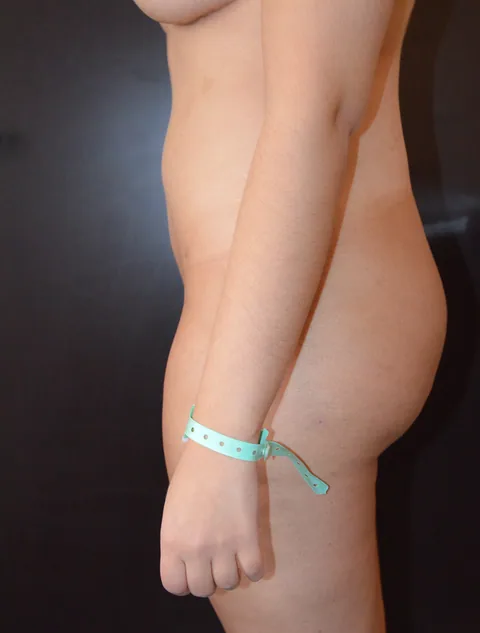
Photo avant lipostructure - Dr Pulvermacker, Paris

What proportion of the fat is resorbed?

After each injection, part of the fat is systematically resorbed in the following weeks.

The percentages vary between studies; a rate of at least 30 % may be taken as a guide. The graft takes over three months.

This resorption is predictable and built into the procedure: that is why the volume injected is deliberately greater than the volume aimed for, and why several sessions are sometimes necessary.

What is the recovery like?

Recovery is somewhat painful and warrants pain relief for the first eight days. The pain is fleeting on changing position and feels like severe muscle stiffness.

A shower is allowed from the next day. A compression garment, usually a panty type, is most often fitted and kept on for about a month, night and day.

Significant swelling appears around the second day and persists for several weeks, as does bruising.

Post-operative care generally includes antibiotics and preventive anticoagulation, to reduce the risk of deep vein thrombosis.

What precautions apply in the weeks after fat grafting?

The grafted area calls for particular care: the survival of the injected fat depends on its blood supply in the first weeks. Massage and lymphatic drainage are therefore not routine after this procedure — whether they are indicated is judged by the surgeon, area by area, rather than applied as a rule. Nurses deliver local care, the anaesthetist follows pain relief, and two review consultations are scheduled, within seven days and between day ten and day fourteen. See post-operative care.

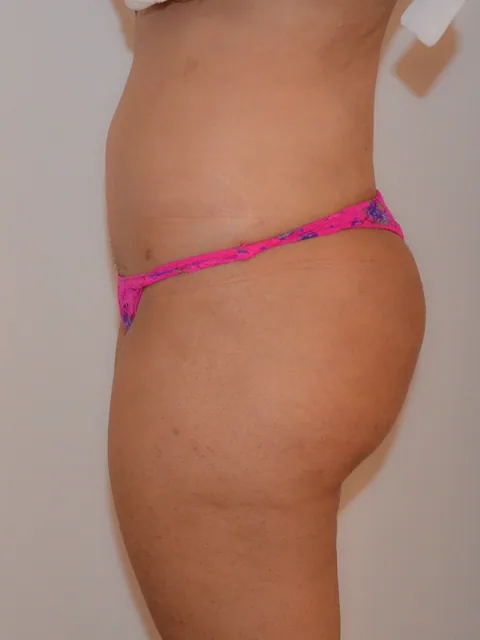
Photo après lipostructure - Dr Pulvermacker, Paris

When is the result final?

The final result can be judged after six months, once resorption is complete and the graft has stabilised.

What are the risks?

The main local risks are an insufficient result and irregularities, which can be corrected by a revision.

The general risks are those of liposuction, in particular thromboembolic ones.

The other, very rare complications are set out in detail in the SoFCPRE information leaflet.

Frequently asked questions

Is lipofilling permanent?

The fat that has taken then behaves like the fat of the donor area: it follows variations in weight. Significant weight loss can therefore reduce the volume obtained.

Do you need sufficient fat reserves?

Yes. That is the main limit of lipofilling: without an available donor area, the technique cannot be offered.

Last updated: August 2026 · Medical content reviewed by Dr Benjamin Pulvermacker, board-qualified plastic surgeon in Paris 16.

Who this operation suits — and who it does not

It suits faces hollowed by age or weight loss — temples, tear troughs, cheekbones — in people with enough fat reserve and looking for a lasting correction using their own tissue. It does not suit very thin people with no usable donor area, those whose weight fluctuates markedly (grafted fat follows weight changes), or cases where the dominant problem is excess skin, which is a matter for a facelift.

Limits and specific risks

Part of the reinjected fat is reabsorbed — in the order of 30 to 40 %, which is why a slight initial overcorrection is planned and a second session is sometimes needed. Specific risks: irregularities or asymmetry, fat cysts, prolonged swelling of the eyelids when the tear troughs are treated, and, exceptionally, fat embolism during deep injection, a risk prevented by retrograde injection with a blunt cannula. The settled result is judged at three months.

A question about this procedure ?

Call 01 47 20 48 70

You are still hesitating

A consultation commits you to nothing.

A proportion of consultations end with no indication, or with a decision to wait. These are normal outcomes, and they are said to your face.

What happens at a first consultation →

Consultation

Let us talk about your plan

The secretariat answers from Monday to Friday, 9 a.m. to 6 p.m.

You have decided

Request an appointment

Give your availability, the practice offers you a slot.

My availability

You would rather speak

Be called back

Leave a number and a time. The secretariat calls you within 48 working hours.

Be called back

You are gathering information

Write to the practice

A question, without an appointment. The secretariat passes it on, answer within 48 working hours.

Ask a question

Or by telephone : 01 47 20 48 70Exchanges are covered by medical confidentiality.

A detailed quotation is compulsorily given at the consultation. A statutory reflection period of fifteen days runs from the moment it is handed over.

Let us talk about your plan

The secretariat answers from Monday to Friday. You may also write : we call you back within 48 working hours.

Lipofilling in Paris 16 — a question about this procedure ?Be called backWrite01 47 20 48 70
Call Write